Phan, L. D. H. (2025). Codesigning Diversity Alter/natively. https://ufdc.ufl.edu/AA00127034/00001/pdf
Abstract
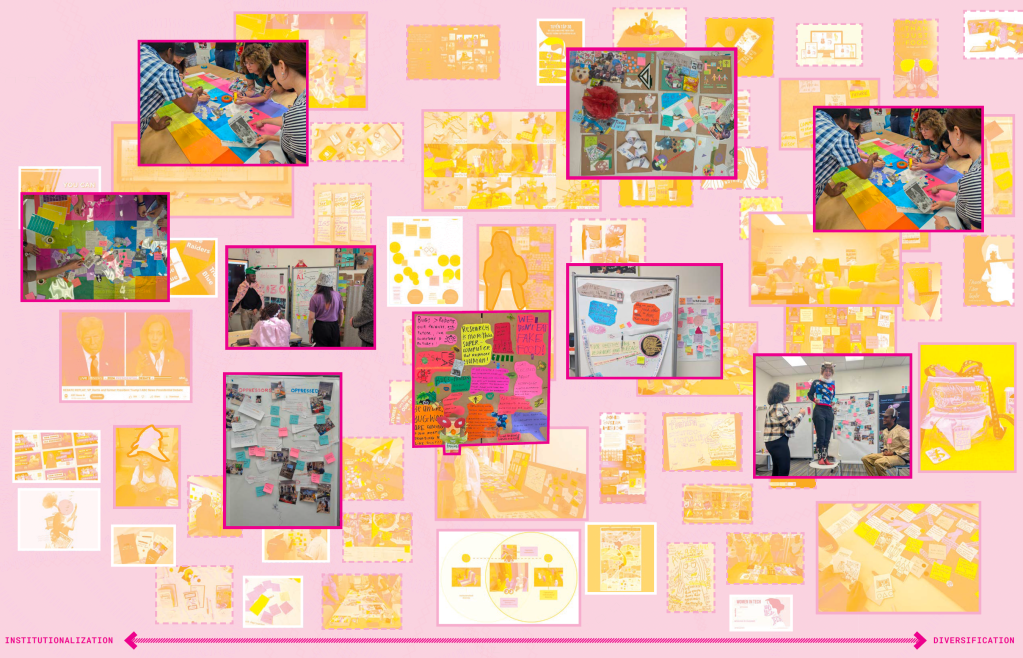
This project in lieu of thesis investigates the contradictions of institutional diversity in the USA’s design higher education through an autoethnographic and codesign-based design research practice. Situated within the context of Florida’s public education system—where anti-DEI (Diversity, Equity, and Inclusion) policies have rapidly undermined critical social studies—this project explores how diversity is both institutionalized and dismantled within neoliberal multiculturalism. Drawing on Sara Ahmed’s theory of institutionalized diversity (2012), the research questions the polarizing responses of predominantly white institutions (PWIs) to diversity, which are either joyfully welcomed or angrily abandoned.
As a Viet immigrant and design graduate student at the University of Florida, the researcher positions herself within a diverse design graduate student body, 77% of whom are from the Global South. Through autoethnography and codesign methods, this project investigates how marginalized student labor sustains institutional structures while remaining underrepresented within them. Understanding each design body as a culturally embedded self with design knowledge and capabilities, this project’s intersection of design and anthropology seeks to both understand and act upon the possibilities for cultural change—beyond the institutionalization of diversity.
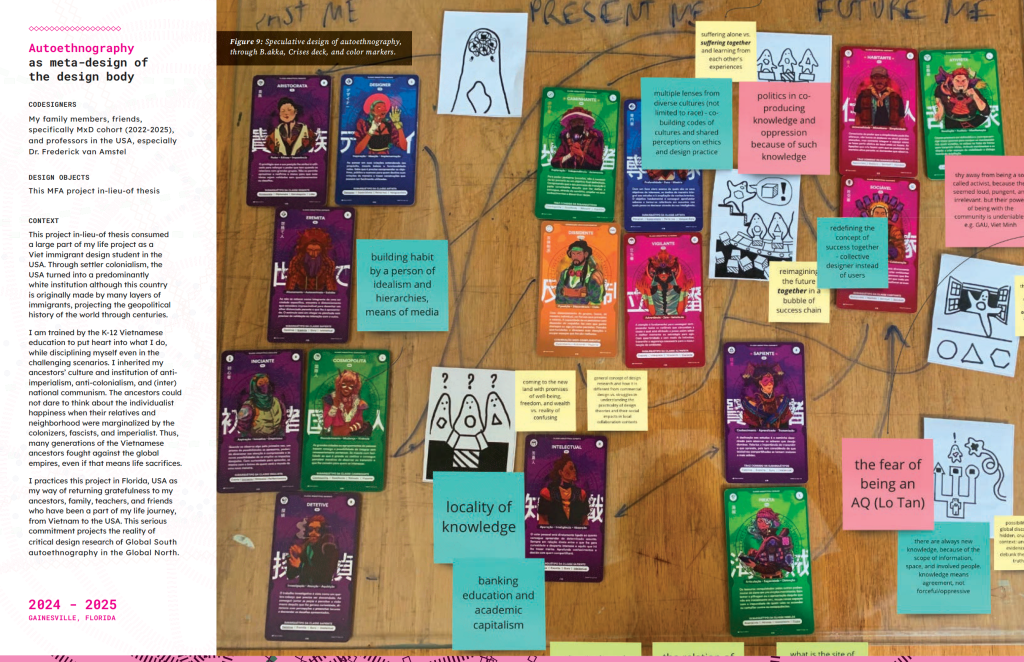
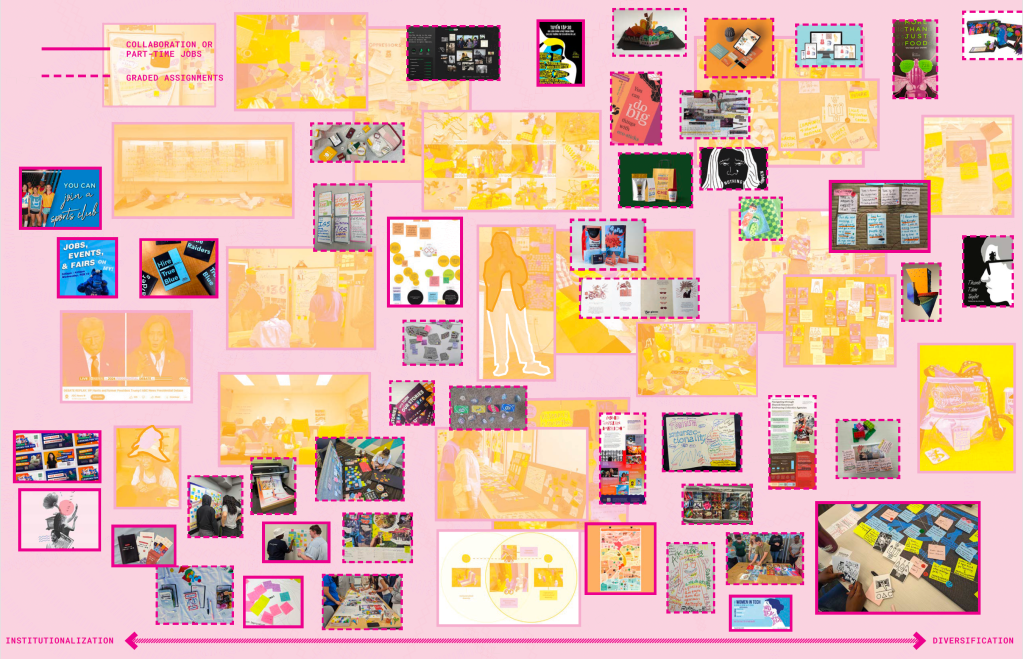
The autoethnographic design research is informed by postcolonial scholars such as Edward Said and Viet Thanh Nguyen. Low-tech materials used within codesign, critical, and speculative design practices draw on the decolonial movements of Latin American scholars, including the Design & Oppression network (2021). Accordingly, the thesis seeks an alter/native approach (van Amstel, 2023) to designing diversity, challenging coloniality in design, such as institutionalization and diversification in design higher education.
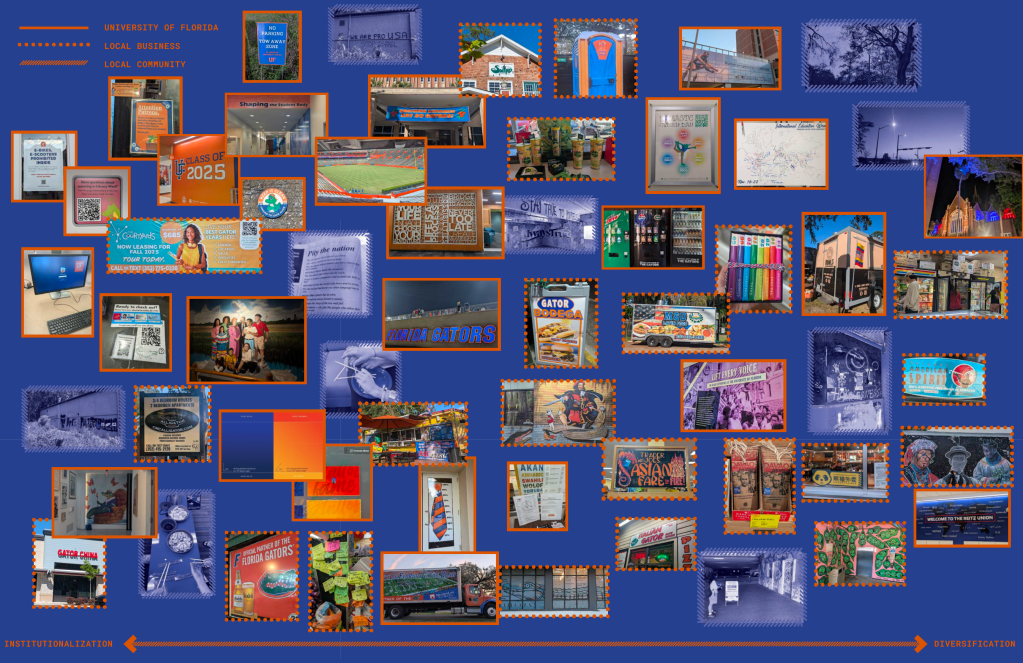
The design of alter/native diversity asks the diverse institutional body to acknowledge the design privilege in underprivileged positionality. Thus, the diverse institutional body is suggested to acknowledge, collaborate with, and co-design with the diverse non-institutional body. Rather than reinforcing the multiculturalism that the institution attracts, fosters, and institutionalizes, alter/native diversity calls for solidarity among many marginalized design bodies — who hold dialogues, collaborate, and act toward equal futures for all.
Download the thesis for the Master’s degree in Design and Visual Communications (MxD)
Acknowledgement: Although a good span of time has passed, this work of designing a collective and self of emerging diversity from Gainesville, Florida, still plays a foundational role to my ongoing research on the design contradictions of institutional diversity. I am grateful of the people that I have met as I documented this work, particularly including the professors that I learned from through the University of Florida like Dr. Frederick van Amstel, Dr. Dori Griffin, Professor Maria Rogal, Victoria Gerson, Seojoo Han, Dr. Malini Schueller, and Dr. Margaret Galvan, besides my colleagues in the MXD/MFA graduate program Santana Nyanje, Narayan Ghiotti, Cassie Urbenz, Alex Hackett, Azadeh Jalali, Lucia Londono, Madison Roberts, Elsie Ofori-Addo, Mohammed Sharif Umar, Dain Won, Jamie Zhang, Tatiana Glakhova, Saeideh Lotfigogarchin, Flory Sanabria, Isabella Arrozala, David Clulow, and Brooke Hull.

 Hien Phan