English is a daunting skillset.
This past Christmas, one of my Viet friends setting her new year resolutions as learning and practicing English better. She regretted that she did not pay attention to her English course in Viet Nam when she was studying college. She gained great scholarships from the university, but her English received negative reviews in the States.
Two years ago, I met a Viet friend falling into depressions as she thought the popular girl in her workspace ignored her because of her English-speaking skill. So every day after that, besides studying for class, she spent lots of times practicing for English pronunciations. She paid attention to the past tense and plural nouns, where the fluent English speakers artistically and effortlessly moved their tongues.
In my sophomore year in the States, I emailed a student service office to ask about tutoring positions. The staff responded quickly within a day, providing me with a lot of helpful information. I replied with an email asking for more details, and he followed up immediately. This new email ended up with the phase “Does that make sense?” It was my first time hearing the phrase and I asked myself “When he asked if this made sense to me, does that mean if I don’t understand it, I would be the problem for being unable to understand this common sense? Am I an annoying foreign student that asks for clarifications so much that the other needs to clarify on behalf of me?” I then responded with a short thank-you email and kept wondering if my ask was such a bothering to the staff. Years later, I learn that this phrase was commonly used in the United States culture and media that at the end of the speaker’s part in a dialogue, they applied this phrase to check in with the others whether they were still paying attention to the speaker. I realized that in that email conversation, while I was not confident in my English skill, that staff might have not been confident in his explanation skills to the non-White student populations either.

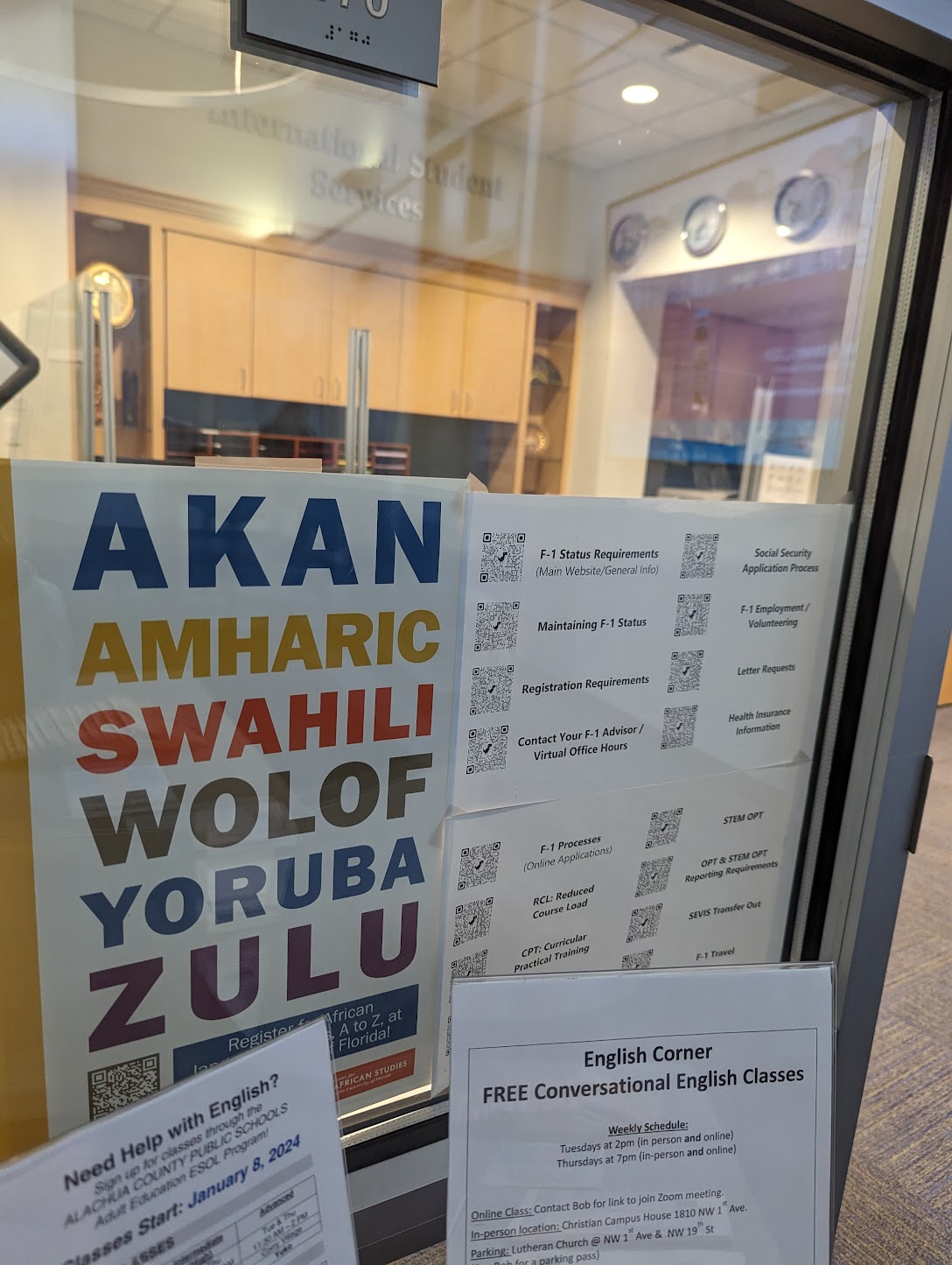
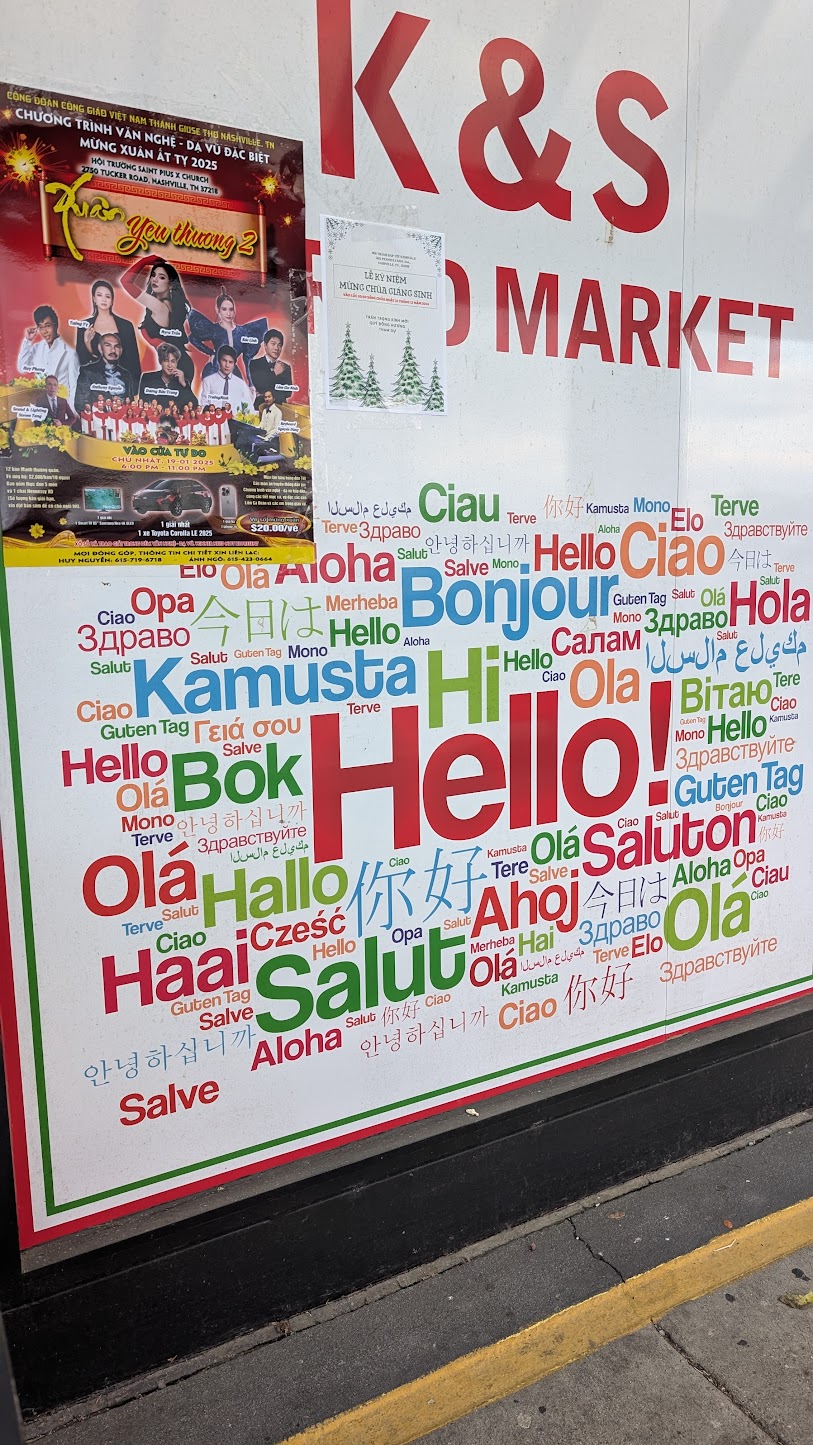
Many languages in the graphic promotions in the United States, in temple, school, and supermarket. Yet, the main language is American English.
English is just among the parameters to affirm “high cultures” of native English-speakers.
In my freshman in the States, I was registering for a Psychology class as the gen-ed course. In the first few weeks of school, a Viet classmate sat next to me and asked, “Can you understand what she said?” On the lecture stage, the professor with short hair sat comfortably on the table, going through the lecture slides full of English words without looking at them. I responded in a questioning tone “Yeah, I do understand them well,” thinking whether I should adopt this guy as my friend. Later on, I remember spending hours memorizing the English phrases in the Psychology class without necessarily understanding them. I remembered the classic photo of the dog and the bell, Fight-or-flight phrase as it is commonly mentioned on the social media, and maybe nothing else. The newly adopted friend was right – I could hear the professors’ words but barely understood her. I avoided to say the truth because of the shame in unveiling my inferiority in language and, thus, culture. I did not want to admit being a foreigner to this space, where both of us shared. It was a mix feeling of embarrassment, jealousy, and hatred towards my friend, which I did not understand at the time.
Another time, when our group of Việt friends planned to go to a movie theater and watch a popular movie at the time, another guy who studied and lived in the Midwest for almost a decade commented on us “Are you sure that you understand what the actors will say? There would be no subtitles as you could watch on the internet or Netflix?” We stared at him as if we could murder him. Most of our friend group just came to the United States. Although we had to take English standardized tests such as SAT/ACT/TOEFL/IELTS before coming here, our daily communication skills in English were still rough. We did not stay here long enough to pronounce the words well, and sometimes we zoned out when others speak in English with us. It was a slap to our faces who just wanted to adapt to the United States culture and enjoy it in our own (foreign) ways. So, ignoring his blunt words, we brought a bunch of blankets into the theater (just like the locals) – some followed through the movie until the After Credits while some were like me sleeping through the two thirds of the movie. He was so bluntly right that I still thought about his words time to time.

The same guy also suggested new Viet friends to relearn English communication skills when they had a chance to visit Viet Nam. Viet teachers will know Viet students better, so they could teach the necessary vocabularies and phrases to Viet foreigners easily. Because of this reason, there were many education centers in Ho Chi Minh city, Viet Nam dedicated for teaching English communication skills, besides the standardized tests. TED talks and movies in English are transcribed in Vietnamese and English for this reason, while several Viet teachers open Zoom classes for Vietnamese American to study the basics of English. In a way, the fluency of English is always a sign of less-than or more-than to the hyphenated American demographics in the United States, or non-native English speakers in a predominantly English speaking worlds.
Nevertheless, even when the non-native English speakers excel English, there are always other parameters to affirm the alienation of this body: skin color, way of speaking, body languages, and so on. These parameters will just keep emerging, initially through personal expressions just like the phrase “Does that make sense?” to institutional racism that has engraved in the encounter of the colonizer-colonized bodies. The guy’s words were bluntly right, coming from an experienced foreign teacher in a local, remote space in the United States.
Swallowing the emotions, non-English speakers inhabited English to survive in the globalized high cultures.
In the United States, there were at least 3 things to learn in order to survive: English, driving a car, and cooking the edibles. Firstly, the language to communicate with people, process through the paperwork which the States systems love dearly and be a part of the popular culture which is also dominated by English-speaking countries. Secondly, driving a car means to own a car and use them to various locations, because the States is a giant developing/ed country, where all living equipment exist but are located far away from each other, separated by highways, cities, and even states. Thirdly, cooking the edibles so that when the foreigners can still cook our own food from the local ingredients in the States which are probably not authentic but partly soothe our homesick.
The two latter skills can be replaced by affordable services such as Uber and Vietnamese restaurants, while the first skill – speaking English – has to be embodied in our tongues, ears, and brains, especially for those arrive at school/universities and learn English through these spaces. English is not just a bodily language but also aTo learn English efficiently, almost all materials need to be communicated through this language, filling in the learner’s world and imposing in the learner and naturalizing the learner’s words. The success of this language probably means the learner think, speak, and write in this dominant language, and sometimes even forgot their mother-tongue language.

Through time, I’m gradually conquered by this language. So as those friends who were once beginners and, thus, commented by the blunt guy. The friends in academics started to replace several Viet words with English words, or chêm Tiếng Anh, just because they are more conveniently produced from their bodies who effortlessly process through English in everyday life. Gradually, more Viet sentences are replaced by English sentences in discussions and arguments. I started to speak English to those Viet guys, taking this globalized language for granted.
Consuming lots of entertainment and educational materials in English, the senior Viet friends talk to the newbie Viet friends in English so they could practice English better. In a group of diverse friends, sometimes the Viet friends could not speak in Vietnamese as they might be deemed as unintentionally excluding other non-Viet friends in the conversations. When Vietnamese is a shared language of the minor group in an English-speaking space, English is suggested as a survival skill or a phenomenon of high-class by Vietnamese American. When Vietnamese in not a shared language of many people in the group, English becomes a common language, a common vehicle for shared interests of many people, and an expressive language of inclusion.
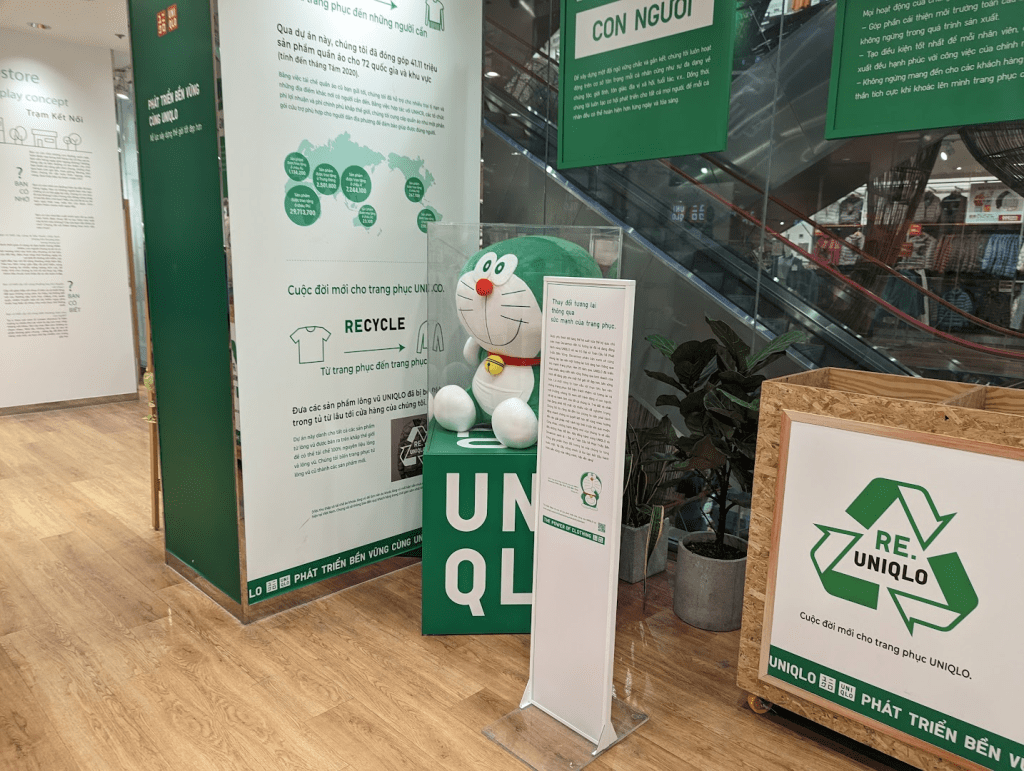
Even now, when you read these lines, you can see that my writing language is dominantly in English. I move to Tennessee quite early, making Viet friends as well as many people in diverse cultures in the English-speaking university space. When I live in Florida, I realized that befriending with non-Viet is as great as with Viet and, that way, English is overtly embedded in my everyday life. Among so many differences in culture, English is among a few common things between us. We shared joy in English, complained in English, cried and laughed after our long conversations in English. Through English, we asked each other about thank you, sorry, and I love you in our own languages. We started to pronounce our non-Viet, non-USA friends with the native pronunciations and intonations, which we probably could not do in our own countries – the Global South countries.
Language is the embodiment of culture and politics of certain nation/region. Language is the vehicle of culture, through visual materials, digital media, and physical cultural artefacts. Language are delivered through words, facial expressions, body languages, the digital email, a TV show series, and a sport news. Through language and cultural materials, the dominant culture expands and consumes the space, like how English has spread as the Great Britain empire’s occupations of global spaces, from now the United States to India. The coloniality of language persists, even though colonization project temporarily ended: when the colonizer’s language is embedded in the colonized’s body as they navigate through the colonial worlds. But does that mean the colonized who speak the colonizer’s language will obey to the colonizer’s worldviews?
Knowing the language opens the doors of knowing the cultures, politics, and the people.
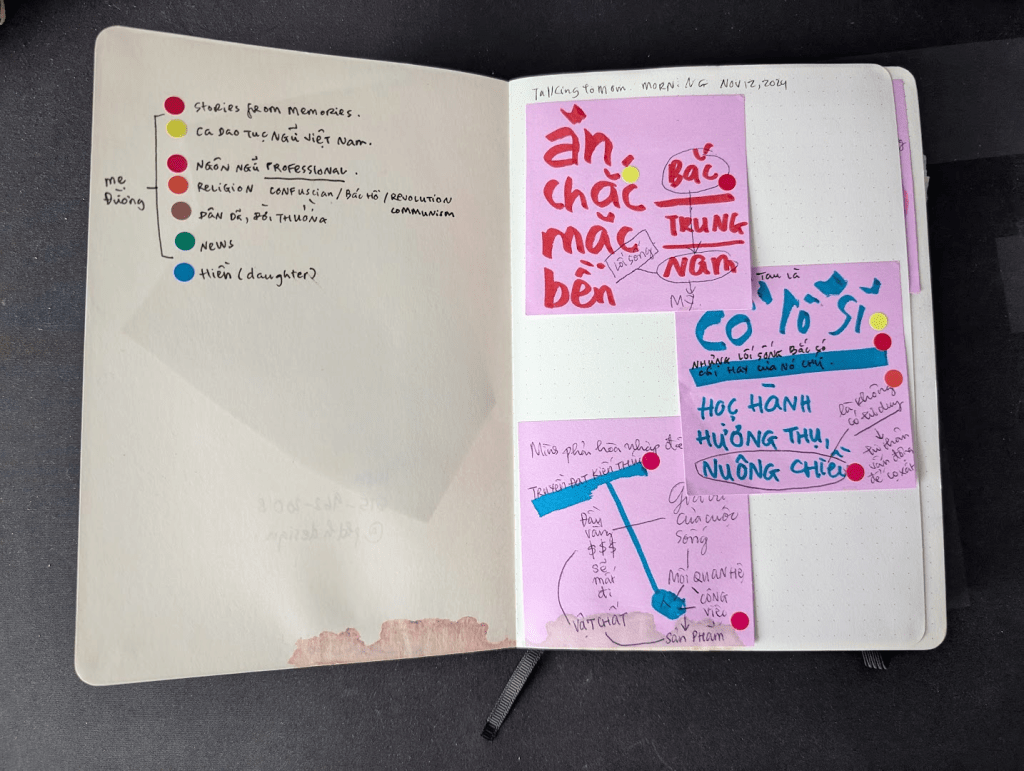
I call my mother quite often. She only knows several classic words in English such as thank you and often smiled with the English-speakers when they said something to her. Thus, my brother and I were usually her translators even in professional works related to this language. That allowed me to understand what my mother was doing and how I could support her with whatever I have. There were many things that when she spoke in Viet, her tones were much more straightforward and critical. Her language is richly embedded with Viet folk cultures whenever she tried to convince me to do something:
Cá không ăn muối cá ươn
Con cãi cha mẹ trăm đường con hư
The fish will be rotten without salt
The children will be naughty without parents’ words
or
Học ăn, học nói, học gói, học mở
You study every little thing in life: to eat, to talk, to wrap as well as to unwrap the gift.
Thus, when we talked through the phones, I did not just listen to how a Viet mother lives but also how the long history of Viet cultures is embedded in her everyday life and now delivered to her children through every possible conflict. Although the modern life is changing rapidly and some of her words seem irrelevant to Gen Z or Gen Alpha’s languages, the Viet folk cultures play as nails to the younger generations, implying how we never separate selves from our roots, despite how far we have departed and arrived. These roots, though across the world, live side by side or even sooner than the Western colonial worlds, while intertwiningly, interactively respond to the other worlds.
At the end of the day, through the ups and downs of learning English and keeping up with Viet, I realized that learning the languages is the important note to understand the colonizer’s world and the colonized’s world. The understanding of both languages and cultures allowed critical comparison of both worlds and decision-making on alternative future buildings. That means, as a non-English speaker, non-White person, I possibly have access to more than one world in Vox or Fox News, through which the United Staters talk about other countries as if the other don’t have a voice or speak submissive languages. Rather, I could understand how the Viet perceives the heroic United Staters and the English-speaking worlds and other chances that we could do things differently. Plus, as many multicultural global companies settled in Viet Nam, they sought for people of diverse cultures and languages in operation. The use of language and cultural comprehension could be applied to critique the overemphasis of modern globalization as neocolonial strategies in the modern days.
In that case, I’m sorry but not sorry for the United Stater friends that demanded non-native English friends to speak in English just because you feel excluded in the conversations. I’m sure it’s just your desire to know the other worlds, but the solution to such desire is always the other speaking your language, instead of you speaking the other’s language or somewhere in between. For us to arrive at your language, you probably have not imagined how we desperately learn English grammars and idioms as a part of our college entrance exams, which most of you don’t even bother to master in; you probably have not imagined the uneased feeling when being gazed and questioned to repeat English words or sentence several times instead of being amazed at; you probably don’t think twice of how your mother-tounge language is a measurement of institutional excellence as well as the feeling at home to the other. Speaking non-English languages in the English-speaking world also shows how we desire to feel at home, just like you in your own world, my dear friends.

One of the reasons English become a globalized dominant language, is because the non-native English speakers are willing or forced to learn for survival. From slangs in media to strategies in navigating through institutional spaces, English is a sign of high cultures that is learnable, mimick-able, and live-able, showing how the colonial inclusion is possible to the excluded bodies through the process of institutionalizing high cultures. Yet, the bodies that don’t share signs as native English-speakers always show signs of misfitting this language, through accent, eye, hair, and skin colors. Accepting this inclusion while seeing the exclusion of it is a willingness to risk displacement and alienation of self, for survival. Just as how Frantz Fanon analyzed the colonized body with black skins in rejection of humanness by the white bodies and thus raising desire of white masks. That’s how the people of high cultures encounter the people of low cultures, blurring the binary boundaries of high-low, colonizer-colonized, questioning its ultimate virtue of colonial languages.
Does this rage make sense?
My professors always asked why I was often filled with rage when speaking about cultural differences in a diverse group of friends. That is because I was among the folks who still navigate through the “high cultures”. In a group of Viet friends, I started as one of the youngest who is always critiqued for slippery words that enraged the elders. In the United States institutions, I’m always one of a few non-white bodies to learn the institutional cultures to blend in. I tend to be the guest who are invited to the socially constructed space of high cultures.
Regardless of this invite, the high culture is always affirmed through itself or the other. International friends are excited to see the United States local spaces and advised me to “listen to [A] from this space because [A] knows better” with [A] as a United States person raised somewhere else but living there since a child. Or a local friend would explicitly comment “I don’t like that – it’s not appropriate” to correct my manner in a conference space. There are representatives of the high culture and its tendency to correct the other of low cultures. The boundaries between high and low cultures are affirmed constantly in the encounter of many bodies, where principles of high cultures are given and to be followed and low cultures to be shared and enjoyed.
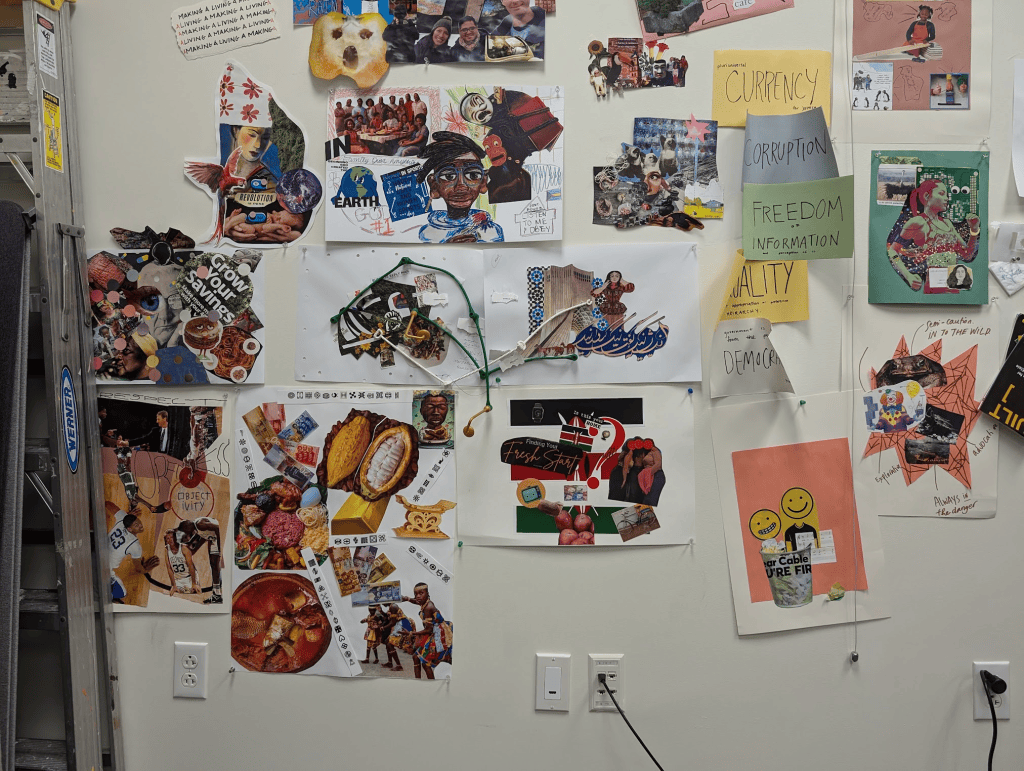
The recent political climate in the Western world has demanded the guests to go back to the countries of low cultures if not following the rules of those in high cultures. While this makes sense as a common sense, the world does not work like these institutionalized boundaries between high and low cultures. In fact, colonial histories take place when the bodies of high culture want to expand their territories and occupy the spaces of low cultures, the coloniality of language persists because of the ongoing colonialist projects, and the people of high and low cultures co-exist inter-dependently. If the binary definitions of high and low cultures are to follow, shouldn’t the colonial histories be subverted, where people stay in their own places and, thus, no world explorations, conquers/wars, universalized humanity needed?
I used high and low in this blog as temporary labels that I’ve learned to refer to colonizer and colonized cultures, reflecting the ongoing colonial histories that persist the globality of English language. However, I have no interest in rationalizing colonial histories or accepting the high-ness and low-ness as the truth.
References:
- Ahmed, S. (2006). Queer Phenomenology: Orientations, Objects, Others. Duke University Press. https://doi.org/10.2307/j.ctv125jk6w
- Ahmed, S. (2012). On being included: Racism and diversity in institutional life. In On being included. Duke University Press.
- Bhabha, H.K. (1994). The Location of Culture (2nd ed.). Routledge. https://doi.org/10.4324/9780203820551
- Chaplin, C. (1936). Modern Times. United Artists.
- van Amstel, Frederick. “Cultural Alienation in Design.” Frederick van Amstel, June 2024, fredvanamstel.com/blog/cultural-alienation-in-design.
Acknowledgements: I was watching Stephen Turban in Saigon Tếu, where the United States man was complemented and supported by the Viet for speaking Vietnamese in Viet Nam (?). This was when I realized the double standards, not only in sexism, but also in classism due to the use of languages by whom. This double standard made Turban shy in the show but, later on, he returned with English and his professional insights in several English-speaking Viet podcasts. Either way, to the Viet, any languages that the English-speaker chooses to use could be seen as the fabulous performances and demand giant applauses. Thus, I wrote this note to analyze a POV of non-English speaker in the English-speaking world. This could be seen as an amateur critique of Việt Nam sính ngoại, chêm Tiếng Anh, or the phenomena that the Viet loves languages, cultures, and products of the dominant cultures like the United States instead of theirs.



 Hien Phan