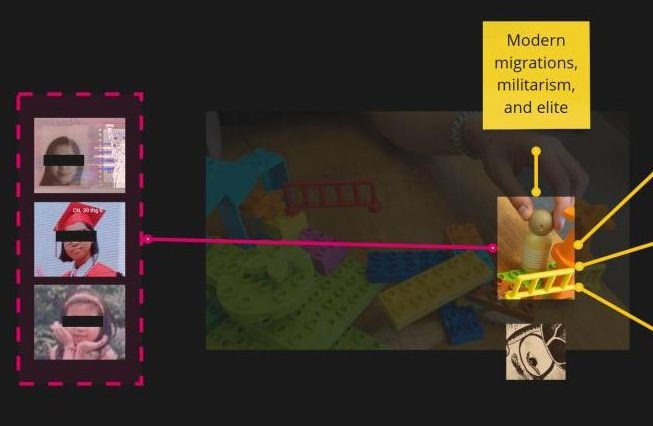
After a heated discussion in which I questioned the elitist biases of the Western neoliberal multiculturalist artists (2026), we participated in creating a sound or dance for others to document visually and verbally, then reproduce it for the whole class. I chose to sing a lullaby that I saw my grandma sing for my cousins in our early years in Sài Gòn.
Giải phóng miền nam chúng ta cùng quyết tiến bước
Diệt Đế Quốc Mỹ phá tan bè lũ bán nước
Ôi xương tan máu rơi lòng hận thù ngất trời
Sống núi bao nhiêu năm cắt rời
Đây Cửu Long hùng tráng, đây Trường Sơn vinh quang
Thúc giục đoàn ta đi mau giết quân thù
Vai sát vai chung một bóng cờ
Vùng lên! Anh em Việt Nam anh hùng!
[…]
In 3 minutes, my voice was much lowered than my loud, confused, and provocative questions in the debate; the sound came from my throat instead of my belly or a sound bar (like the times that I blasted K-pop sounds); words were distorted, scattered, and almost reduced to gentle tones like “floating clouds,” as my partner noted through the Zoom session. The song’s magnificent rhythm, once an anthem of the Viet independence guerrilla army, softened like a distant fall from the jungle filled with sounds of weapon transport and marching steps. Without the language translation, one can just say this is a dreamy song full of love for the other; it’s the opposite, with a clear political stance of the Viet anticolonial movement in the 20th century during what the Western would refer to as the Vietnam War. One might ask: How come a historical, anticolonial song is sung as such a sentimental lullaby?
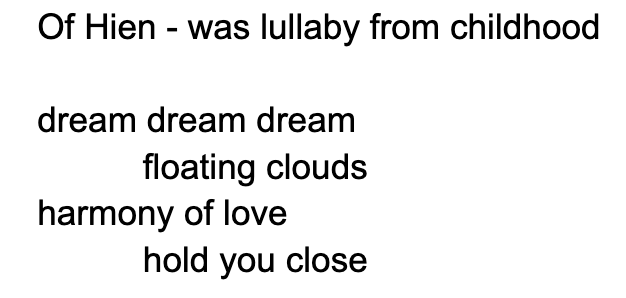
I came a long way to this answer at the end of this blog, although it’s still an ongoing craftsmanship of the psychoanalytic answer through my encounter with the other in the USA. In my memories, my grandma would hold her purple wooden fan in one hand and pat my cousin’s shoulder with the other, while her rough but soft voice emphasized the line “Vùng lên! Anh em Việt Nam anh hùng!” It was not the only song that she sang, but many songs that describe the Viet during the anti-colonial wars, like Bên bến bờ Hiền Lương (Hiền Lương-Bến Hải is the bridge built by the French in the 1920s and used as a division landmark of the north/south of Vietnam after the Geneva Conference in 1954). The series of anticolonial songs, through my grandma’s soft rhythms and warm body, brought my cousins to their day naps as their parents were away for suburban work.
Years later, as my grandparents lived with my eldest uncle, my other uncle raised his sons without my grandma’s lullaby, but with digital streaming of the lullabies. As he and his wife fed my other cousins, he would turn on the constructivist songs in Viet rural contexts, like Thuyền anh ra khơi khi chân mây ửng hồng, on YouTube. The songs became signals for serious breakfasts, where the kids had to finish their portions so my uncle could rush to work on time. During the day, my aunt and mom would turn on songs on YouTube as they fed the kids at lunch and dinner when working from home. The kids picked up the words quickly and sang along: Ớ hò ớ hò. They laughed as we laughed at their singing and ran around, sometimes vomiting what they’d just eaten. The songs sometimes became the background of the parenting battlefield near a T-intersection in central Sài Gòn. Years later, I was able to foreground this violent manifestation of anticolonial patriarchy (Ahmed, 2006) through my zines about intersectionality on Viet women in my family (2023).
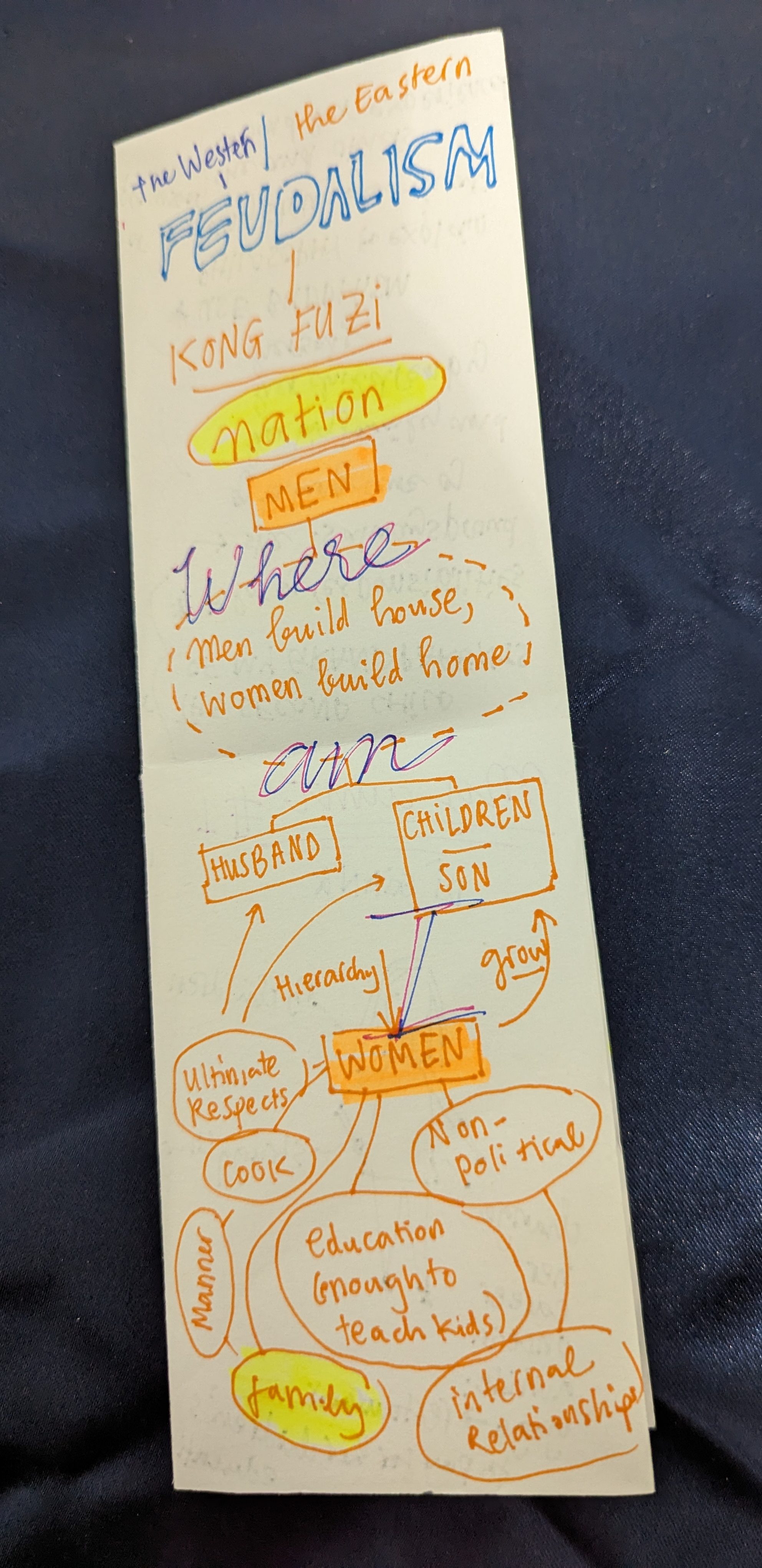
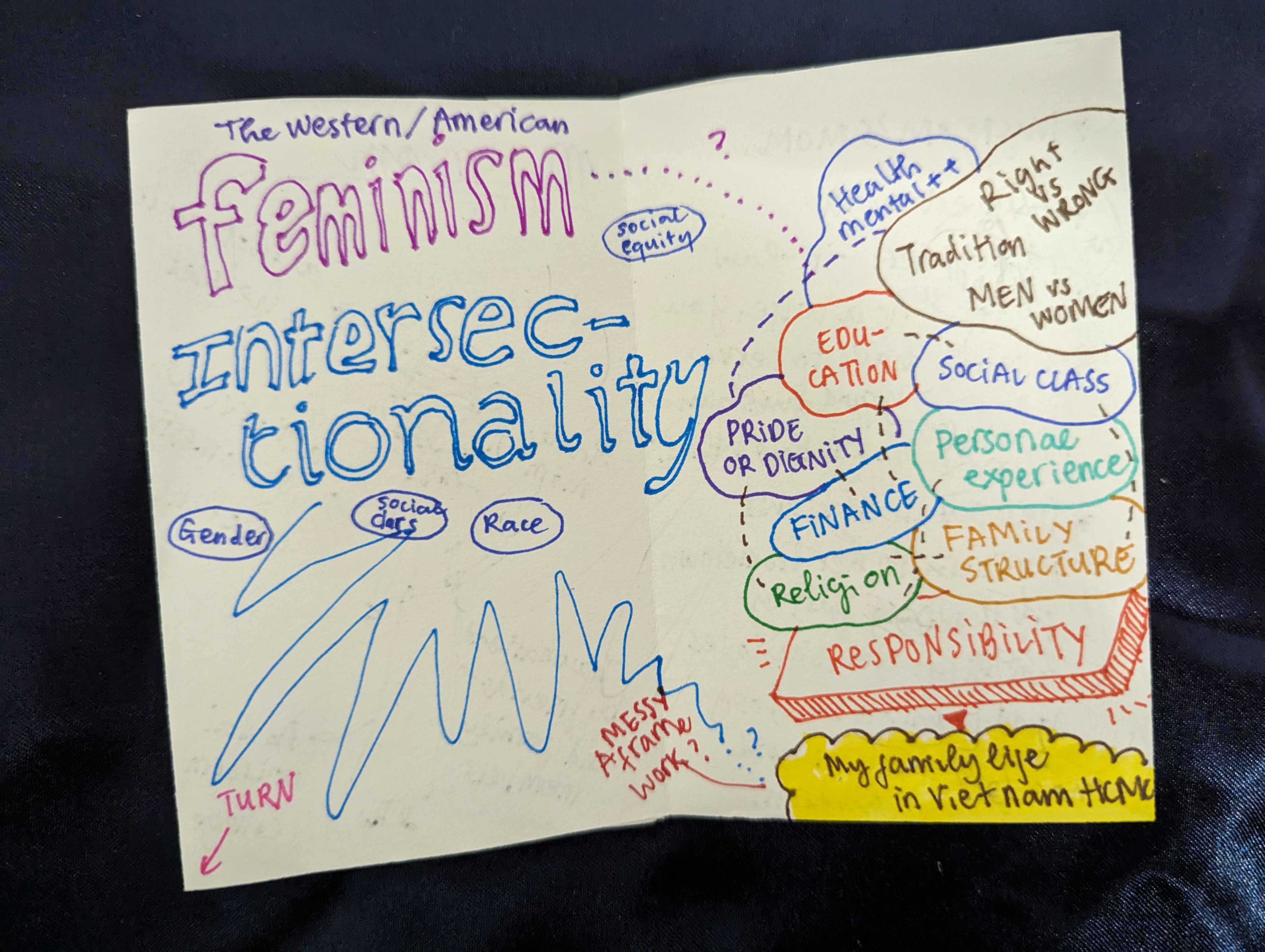
At such times, my mom and I would be pushed out of the parenting space as we tried to shield the kids from the uncle’s beating. My uncle’s wife was asked to watch the battlefield in silence and eventually got involved when things got out of hand. The women in my family were deemed inefficient protectors of the kids, unlike the principles from the dads who were trained in the government’s military, which is the modern turn of the independent guerrilla army forces. The anticolonial forces of Vietnam remain very impactful to the Global South, with imperialist interventions from the European and the Western, showing that economic independence is the fruitful result of long-term national and social movements. In Vietnam’s postcolonial space, this national movement travels through anthems, lullabies, and everyday household activities across many generations. Yet, unfortunately, gender inequality in Vietnam, especially among families with ties to occupational military training, is not cared for enough.
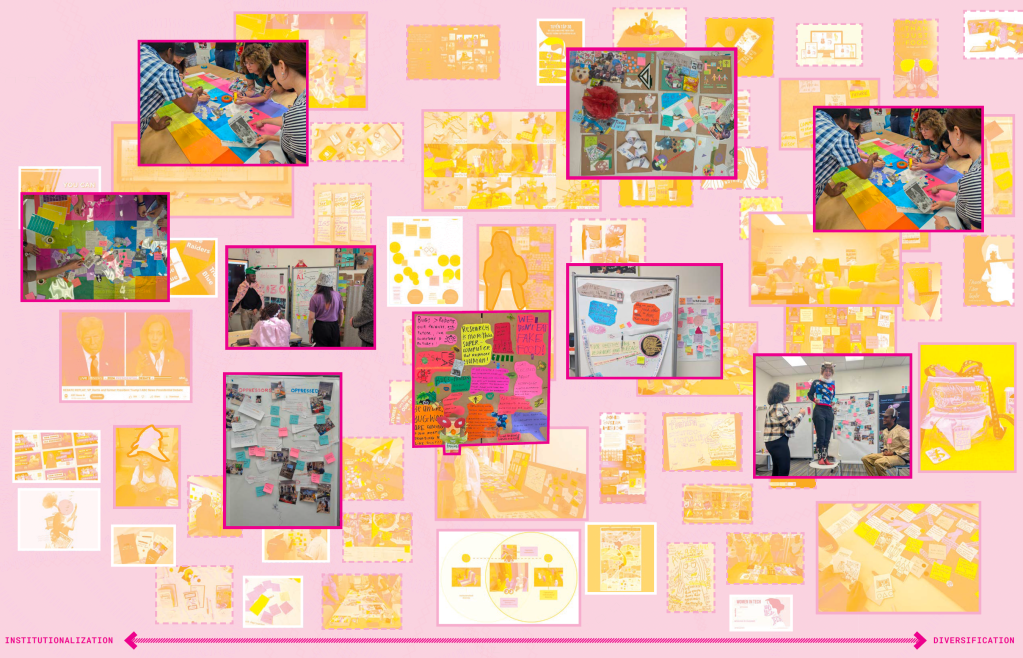
Women, like my grandma, mom, and aunts, carried the national movements forward by embodying anticolonial anthems through soft voices, bodily gestures, and caring eyes for children. They worked in the assigned roles of building homes/interiors for the household, while men built houses/exteriors. These workforce divisions inherited Confucian patriarchal and colonial rules, along with localized strategies from the anticolonial wars, and are being further enforced in the nation’s participation in the market economy. With the risk of population aging, women bear the main responsibility for having children to help the nation sustain its productive workforce. In the family planning and parenting battlefield, women are called for, needed, and easily pushed out, which contributes to ongoing contradictions of gender inequality in the Global South anticolonial movement (Fanon, 1967). This contradiction becomes clearer in a re-reading of institutionalized diversity through Lego Serious Play in an early phase of my MFA/MXD thesis (2024).
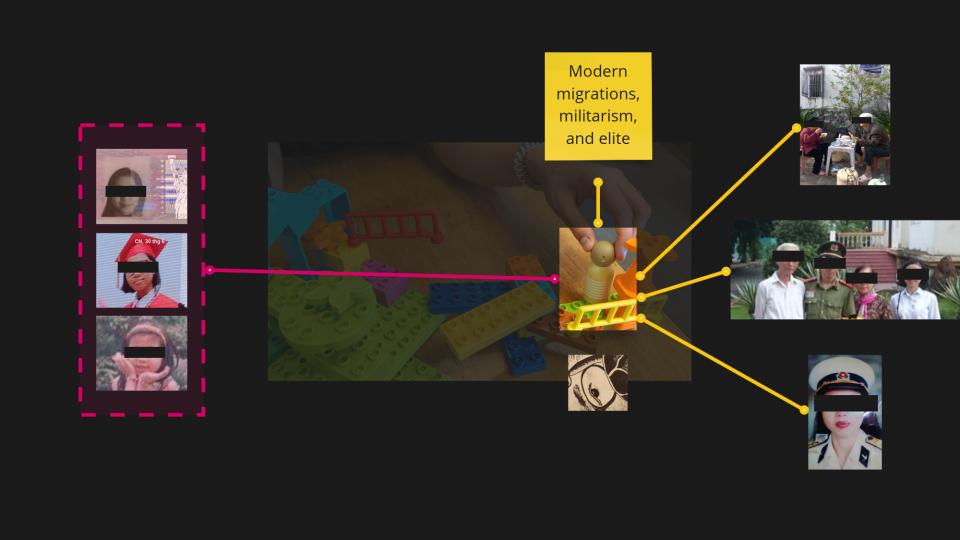
In the application of systemic oppression (Van Amstel et al., 2025), women in this case can be understood as both designers and users of national movements as service meta/infrastructure. They give birth to descendant generations for Vietnam’s economic development, which makes them designers by biological function. Yet, they are also tasked with raising these generations in certain ways that meet the narrative of the national movements, inheriting the contradictions of gender inequality through socio-historical cultural patriarchy, which generally makes them users by social function. Not a small portion of Viet women climbed up the workforce and political ladders and became leaders in exceptional fields, but they were criticized by misogynist comments that demeaned their contributions. This demographic includes single moms and single women who choose neither to marry nor to stay in traditional marriages and household roles as assigned.
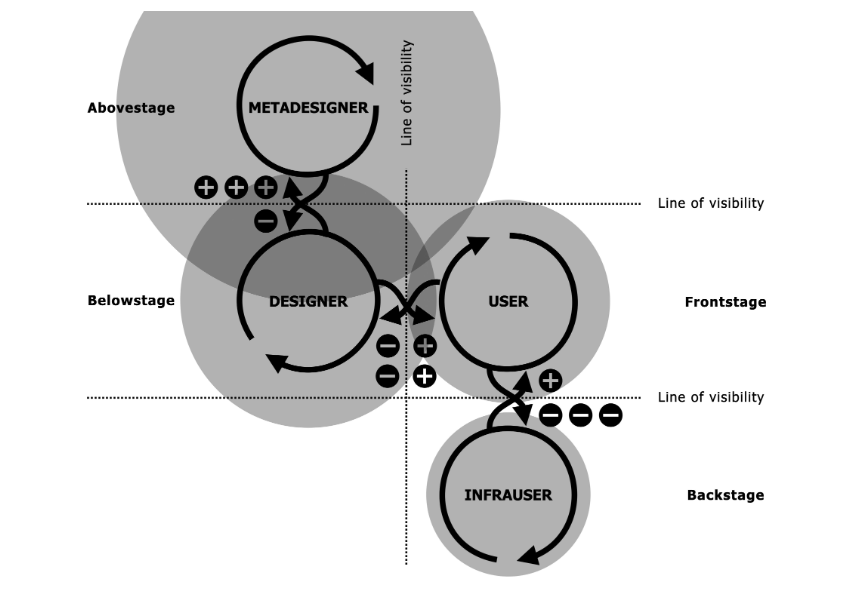
Given women’s in-between role in households and the workforce, as two critical stages for national movements, it is neither ethical nor practical to assign them roles, celebrate them with fancy titles like Bà mẹ Việt Nam anh hùng, and then discard them in these movements. The past few decades in Vietnam marked an economic boom, which was also marked by recent social issues like rape culture in Vietnam’s workforce, interracial/intercountry marriages between Viet women and foreign men, and tourist services of Viet indigeneous women and children in rural areas. This suggests the far-reaching impacts of gender inequality in Vietnam.
Back in the day, as my cousins slept, my grandma sang lullabies for her grandchildren. As they woke up, she would turn on Paris by Night and watch Nguyễn Ngọc Ngạn and Quang Lê. My cousins and I also sang along with the Vietnamese-American musical productions and even performed a dance during the Tết holiday in front of our family, when we were middle schoolers. To anti-colonial national movements, this mimicry would be heavily criticized as welcoming Western interventionist cultures and undermining national cultures, given that Paris by Night was a cultural production of Viet colonial mimicry in Western space. This is also evident in my early design work representing Viet mimicry identities in neoliberal multicultural space in the USA. These identities were shaped during my time in neoliberal multicultural institutions but also trace back to my early days with my grandma, who watched many Viet artists and singers in áo dài.
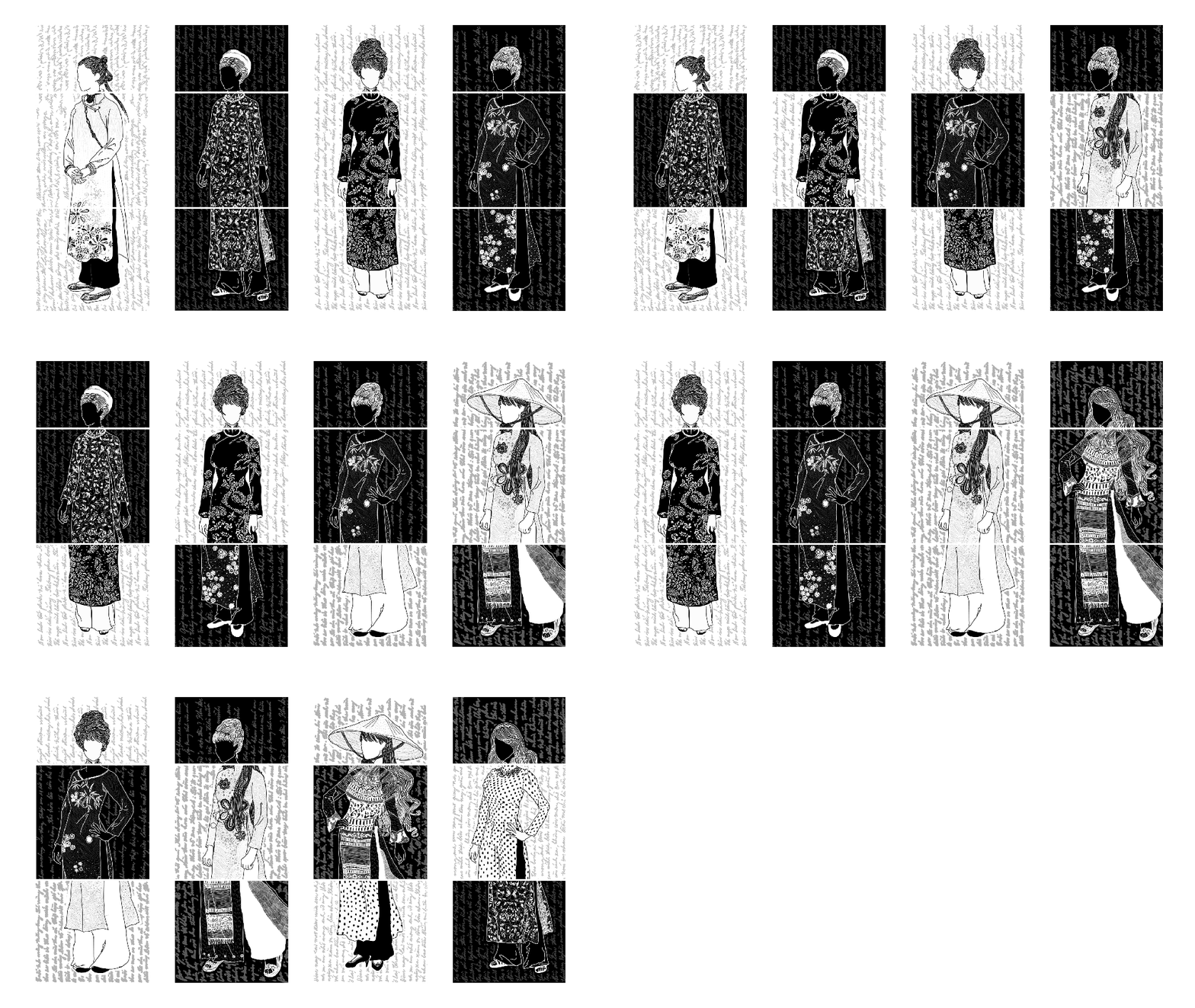
But, wait there! My grandma’s access to Paris by Night is made possible by the encounter between the postcolonial stage of Sài Gòn cultures and the national movement in the market economy. This encounter has made the increasing integration of digital media streaming possible and accessible to the masses. Also, remember that one of my uncles streamed constructivist music on YouTube as the background for his parenting battlefield. Digital media streaming was among the infrastructure technologies that my uncle used to enter the workforce as a responsible worker, reproducing patriarchy through violent parenting, while entering a single-household capitalist structure. This explains the absence of my grandma’s lullabies and maternal impact on grand-parenting. The contradictions of gender inequality are further emphasized when national movements encounter the postcolonial debris of geopolitics and the capitalist market.
Returning to my soft reproduction of my grandma’s lullaby in a sound/dance practice at the beginning of this blog: it was my response to the biases of Western neoliberal multiculturalism that I gathered from the previous meetings. There, the men of Viet’s anticolonial movements were seen as barbaric and violent for their guerrilla militant tactics. There, women and children in an oriental space were deemed to be rescued by Western heroic figures. I disoriented myself (Ahmed, 2006) from the biases through heated discussions to clarify the roles of anticolonial movements, while also re-oriented subconsciously to reduce the patriarchal effects of the anthem lullaby in me. Yet, I’m still finding ways of designing to disorientate from both forces: the colonial and postcolonial movements that are backed by socio-historical patriarchy, and it’s still a long process.
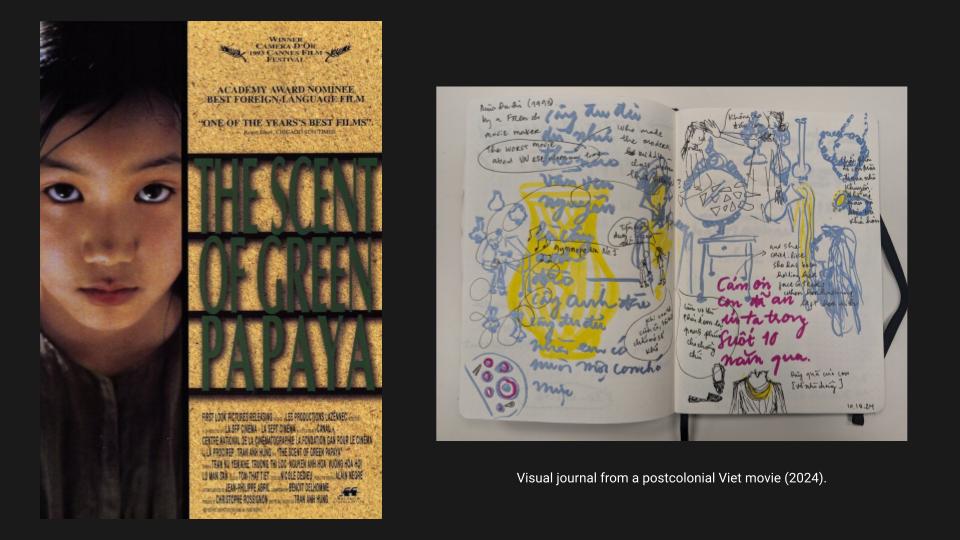
One of the answers that I’m not fully agreeing with or comprehending, but still practicing regardless, is climbing up through and across the Western neoliberal multiculturalist institutions. For an active design of alter/native diversity to re-orientate the impacts of institutional designs on it. Gender inequality was a contradiction in Vietnam’s postcolonial spaces, as women and non-binary genders were undermined, yet became the statement for social designs for the subalterns in Western/Eurocentric spaces. Like the Eurocentric movie about Vietnamese women, such as Mùa đu đủ. Like my naive consciousness when designing for the exhibition of Viet identities through women’s aesthetics that left me recognized in a neoliberal multiculturalist institution.
References:
- Ahmed, S. (2006). Queer Phenomenology: Orientations, Objects, Others. Duke University Press. https://doi.org/10.2307/j.ctv125jk6w
- Fanon, F. (1967). The wretched of the earth. Penguin.
- Freire, P. (1983). The importance of the act of reading. Journal of education, 165(1), 5-11.
- Van Amstel, Frederick M. C., Serpa, Bibibiana, Secomandi, Fernando. (2025). Systemic oppression in service design. In: Suoheimo, M., Jones, P., Lee, S., Sevaldson, B (Eds). Systemic service design. Routledge. http://dx.doi.org/10.4324/9781003501039-7
 Hien Phan