
Context
This is a recorded lecture in Design Technology, Spring 2025, at the University of Florida with the instructor’s writing adjustments after the class.
As we talked a bit about what to observe and what to document in a visual journal, you can also take notes during this lecture as well, if that’s helpful. I would like to introduce a bit about why I document, what I document, and how that relates to my positionality. A journal can be very personal, and it depends on what you pay attention to. Because of that, each visual journal is drastically different (even if the designers document the same things).
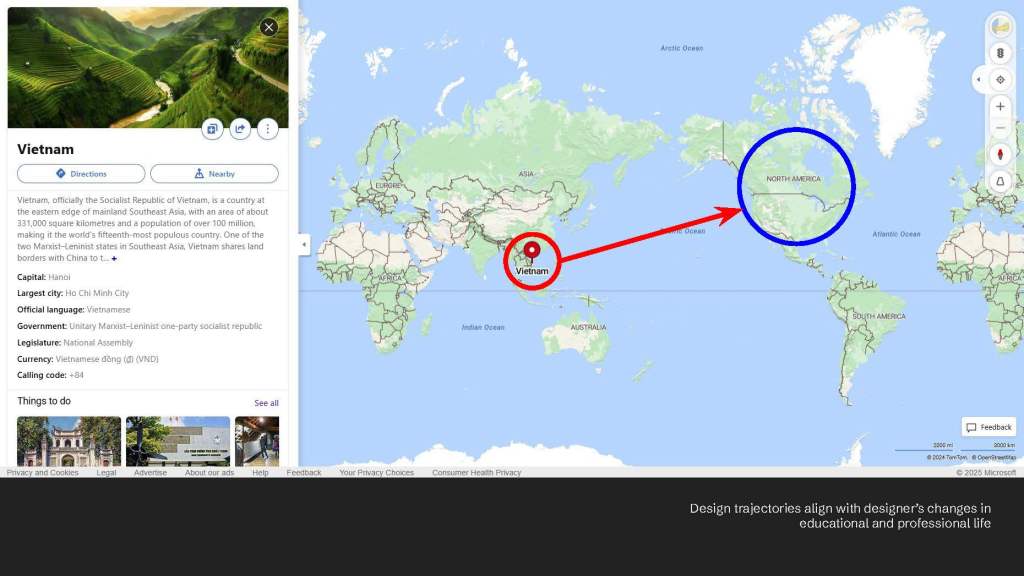
I would like to share why I collect a lot of materials and what that link means to me. As you might guess from my name, I’m not local here; I’m Vietnamese. I traveled here, to the United States, for school. This space was quite the contrast (to where I was from). From the urban area in southern part of Viet Nam, Ho Chi Minh City, I kind of understand the United States as a space of modernity, full of technology and industrial areas through digital media .
I get to know the United States through my lived experiences, which is different from how it is represented in the media and digital technology. (So as how Viet Nam was from my lived experiences in comparison to how it was represented.) Here, in this digital map, you can see that in Vietnam is shown as the synonym with the agricultural landscape, which is drastically different from what I told you about my lived areas – Ho Chi Minh City, one of the two populated cities in Vietnam. You can imagine it as the New York City of the United States, full of tall buildings. Viet Nam is (mis)represented to embody its contrast from the developed countries with highly industrial spaces such as the United States. This lack of representation implied the possibility of misrepresentations in the digital media, which we as graphic designers often take it for granted as the inspirational board.
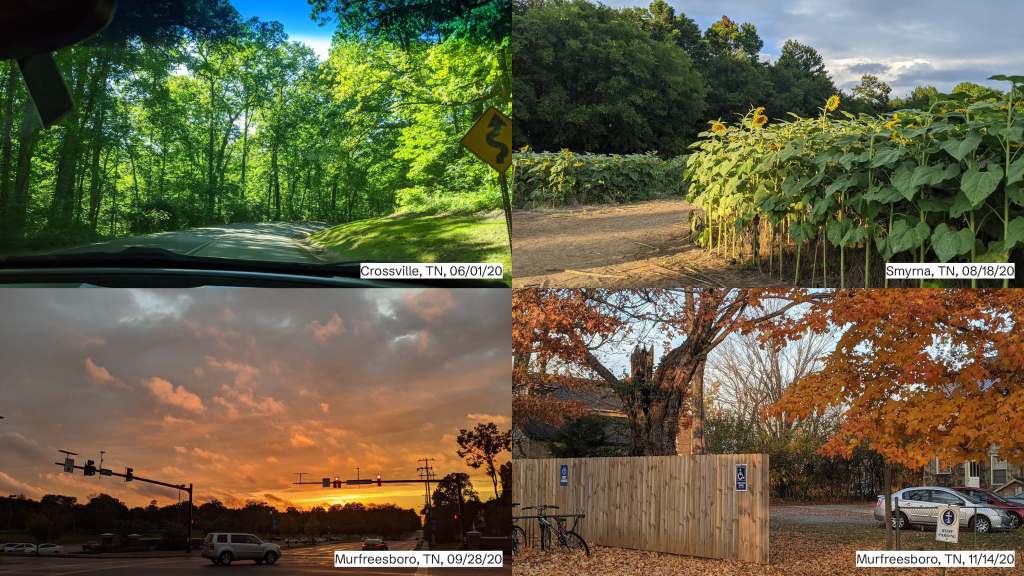
In the upcoming slides, what I have documented allowed me to analyze the design space in the United States through my lived experiences. I go to school in a campus town in Tennessee, the Midwest of the United States. I have a lot of access to nature because of the geology of that space. My phone camera has captured a lot of photos of Tennessee nature. If I could share them with you, there would be the skyline made of several buildings of the campus and the rest of the photos would be blue skies or green plants. This allows me to understand, okay, well, the United States through media or through graphic design, is actually representative, but also has a lot of opportunities for misrepresentation. Because they are not exactly as what I live!
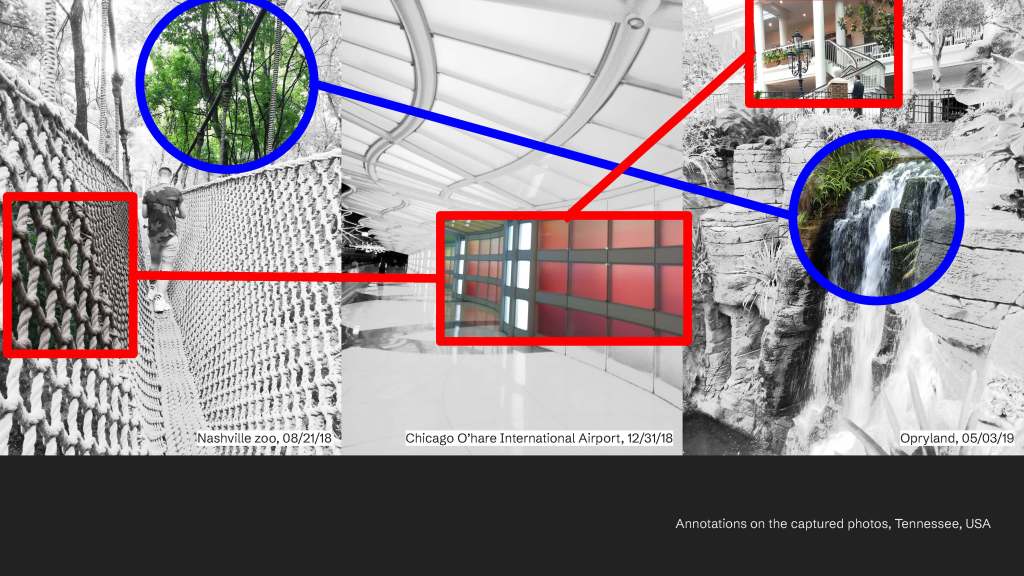
So, I started documenting as I was exploring the new spaces, beyond the campus or the nearby natures of the campus town. I went to the Nashville Zoo in Tennessee. I went to the International Airport, which I have to commute between Vietnam and the United States. I also went to one of the biggest convention centers, which is Opryland. I see that the design of nature and architecture share common things. The blue codes represent the presence of nature while the red ones represent the design possibilities that have been added along with nature. And I see that there are a lot of grids in the design to showcase modernity in styles. We use a lot of geometric shapes in our graphic design practices, right? We also use a lot of vivid colors, which can be seen through the international airport in Chicago. We can see geometrics in the hotel exteriors as a part of the Opryland Convention Center as well.
Going back to that, what are the design objects here?
Well, I would say the dome of the conventional center also has a lot of grids which is connected to the hotel, the bridges, and the nature. So, in that case, nature is actually brought into the design space, along with the modern design, shown in the grid, for people to live in. This is designed to be a space for people to enjoy nature while still having access to entertainment in many ways. And why is there a dome design like that, so that you can see through the sky? Among many reasons, this might be also because: during my process of exploring this design space, I get to know that throughout the year, even in the summer, or winter, we still have a somewhat okay temperature to go in this center and hang out with our families and friends. So, the dome was designed to sustain the temperature, and it also has different (cultural) meanings in architecture, religion, or whatever was trending at the time. I would not go through such details for this analysis. However, this understanding allowed me to compare Tennessee and Florida, which is in the south but already very cold today. The cold is more intense when it goes up north, including Midwest. The space was designed to afford the local geology.
Besides, there are many spaces within this conventional center. During the year, we will see that the same space could be used for fountain in the summer and Christmas tree in the winter. So many spaces are repurposed to fit in the themed celebrations across the year. During the summer, it’s very green; during the winter, the light design from the dome has been reflected through the river. Although plants seem naturally developed, they are actually placed and grown with intentions, like the trees in our campus town that you can look through the windows. The space is designed and filled with design objects that meet certain demands of the local users. In the winter, the outdoors green in Tennessee is often absent, instead of what we can see in our Floridian campus town today. However, in this conventional center, we could still see the green even in the Tennessee winters.

Here, you can see that, users occupy the space by using the services, interacting with the design objects, and taking photos of themselves in the design space. This was a high school prom while in other angles, you can still have other kinds of aesthetics. The vast design space indeed includes many kinds of design objects as well as many functions in different areas. The design space can be seen through time and space, as they could be updated to the trends and new demands of local users if needed. Thus, the very massive design space here, allows many opportunities for nature to be embedded, seasons to be repurposed, and demands in travelling and entertainment to be met. In comparison to the gloomy space in the wintertime, this conventional center is a concentrated design space for users’ needs and designers’ creativity.
Small and large businesses are available for users to come in and enjoy different kinds of entertainments, school prom, Christmas, and also sharing beyond this conventional center through the digital cultures, such as the social media platforms. It indeed serves the demands of local people here in the cold places, right?
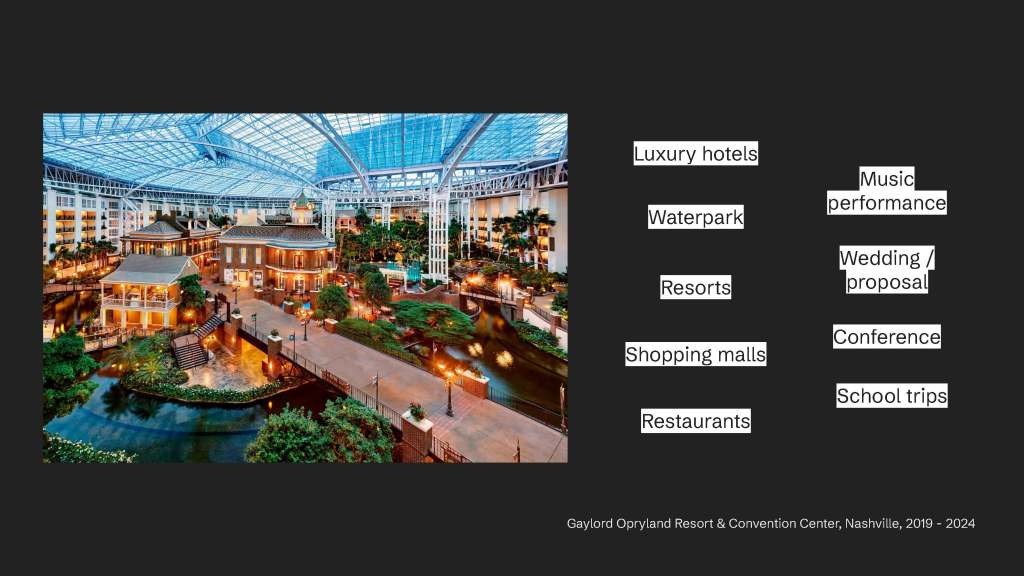
In this context, I would like to emphasize the little design objects within this vast design space for many, many purposes. Um, and during this process, because the space is dedicated to many kinds of businesses, people can also have different kinds of interactions as I said. They can take photos, they can dine in. There are also shopping malls connected to this resort. They can also live within the hotels which are like the walls of the nature here. So, if you see, the nature is like a rounded pan, then the hotels are like the walls around that pan of nature. Then the dome on top is (like the lid!) to hold and protect everything together.
The center could be repurposed for conference school trips, personal events such as weddings, proposals, music performances, so on and so forth. Although my professional field is designer or, more specifically, graphic designer, I came to that space as a user. When the users come to that space, they started to embody the aesthetics of such space, in the winter or the summer. This is how the local people celebrate the culture in their own way even in a shared space.
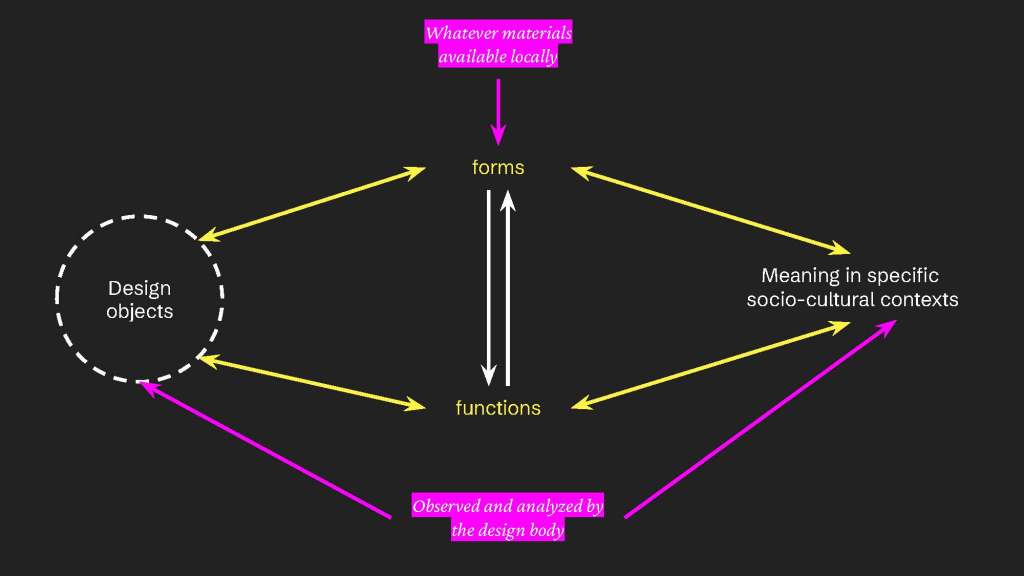
Externalization and embodiment are the vocabularies mentioned in the article when the design body interacts with the design objects. The design body, or specifically users in this case, approach the design objects in the environments as designed by the absent designers. The users, thus, externalize their creativity through their interactions with the design object. Or even create new design objects outside of that space. So, that’s how culture is created from the design object, projecting the design body’s creativity through interaction.
This is the Christmas tree from the convention center, Opryland, that I just shared. I want to emphasize this design object because of its varied form and functions across the space. The Christmas tree here is made from light of many colors. As graphic designers who love vivid colors, we also commonly use the geometric shapes, right? So, this is the application of modernism in the design space. Coming to another space, which is also in Tennessee as I like to observe and document as I travel to the new spaces, the Christmas tree here is designed differently. In Cheekwood, another conventional center, we can see the femininity in the Christmas tree made of pastel colors and leafy decorations. The artist wanted to express her unique feelings of the season and externalize her aesthetics through the creative uses of materials.

When I visited St. Augustine, which was in the last week with my grad cohort, I saw many Christmas trees that were actually planted from the dirt, outdoors, in the not-as-cold weather. Here, thanks to the tropical areas, Christmas season could be celebrated outdoors where the local and tourist people could enjoy whatever nature offered to them. During the walk, I also saw some workers shaping the top parts of the tree to resemble to the tall triangle of the artificial Christmas trees in other conventional centers. The decorations were put in the real tree to demonstrate the presence of the holiday season even in January in Florida, United States.
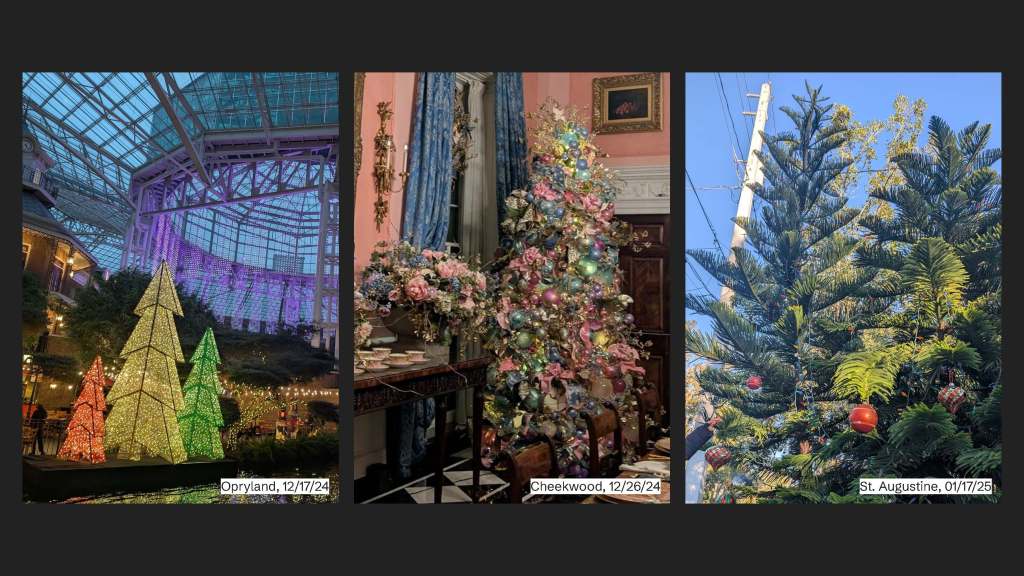
So, you can see that the Christmas tree is the design object now, the environment of the Christmas trees is also filled with other design objects, altogether crafting the design space that is celebratory. It is called the holiday season because the design space can be extended from the beginning of December to January of the following year, beyond the Christmas eve or day. The design space, thus, links to the design culture, not necessarily because of the original religious meanings. But because of the availability of the design objects that allow possibilities for us, the users, to embrace the Christmas tree and the culture of family & friend gatherings. This season happens to align with the school break and the end of the year.
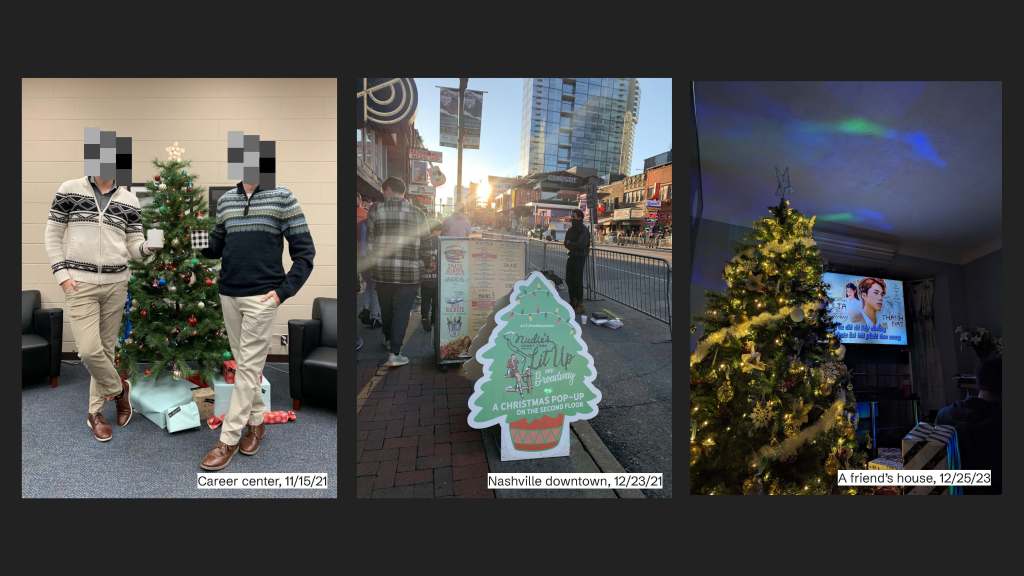
Because of this reason, the Christmas tree takes place in many spaces: customized in the smaller size to be decorated in the University spaces such as the Career Center in my school in Tennessee; cardboard in the middle of downtown to promote for a street business; and inside my friend’s house, next to the TV as the background for our annual gatherings. This is how the users externalize their creativity in their own space to embody the popular culture. The outdoor natures are brought to the indoors space, where its form is adjusted to meet the celebratory purposes, creating a charming environment for personal or business.
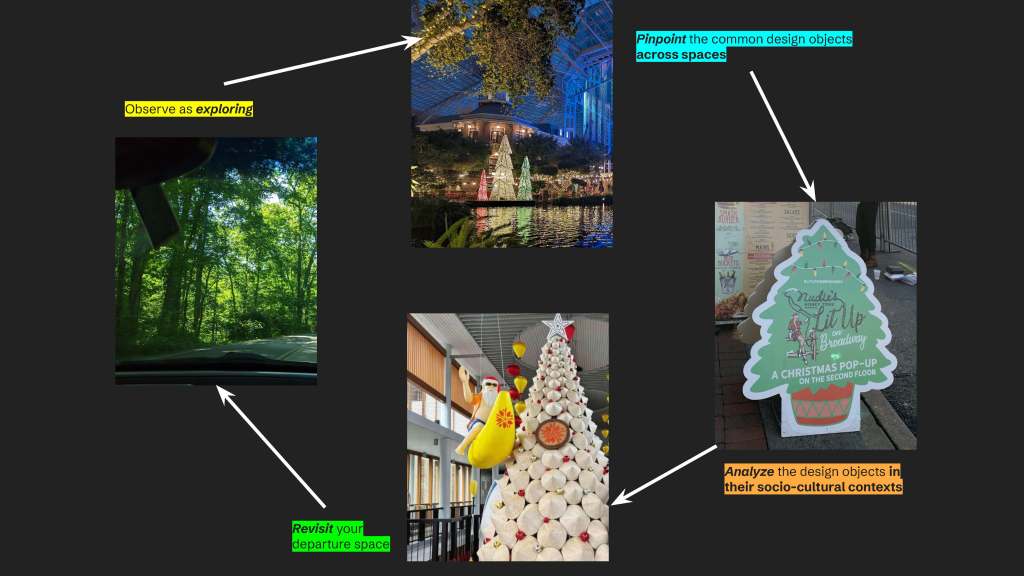
Thus, I have captured my route in analyzing the design object across spaces: (1) Discovering the space while documenting it with whatever tools that I have, which was my phone camera in this case; (2) Pinpointing the common things across the spaces that I travelled to, with the question “What is the design object that is potentially mass produced and seen in other spaces?” (3) Observing the design objects within the social contexts, with the question “How do people in different spaces interact with the commonized design object?”
In the initial comparison, I saw that the Christmas tree is decorated with colorful lights and geometrics, which creates the ambiance of the Christmas, or the winter season, right? Then when this design object comes to other spaces, it brings in the new space with its culture, even though the new space does not have the same elements as in the original, religious space such as snow. Regardless, people can come and gather in their house to celebrate and exchange gifts in the excuse of celebrating the Christmas season, not necessarily for religious purposes. We commonly sang the songs Feliz Navedas, All I want for Christmas is you, or Last Christmas, while baking food and commuting for the potluck in this season. We can see that, although Christmas tree is present in many spaces that I shared with you, it is in different social contexts and has different meanings. The different forms and functions of the same design object project the creativity of the design body, who are the users now becoming designers of their own space.
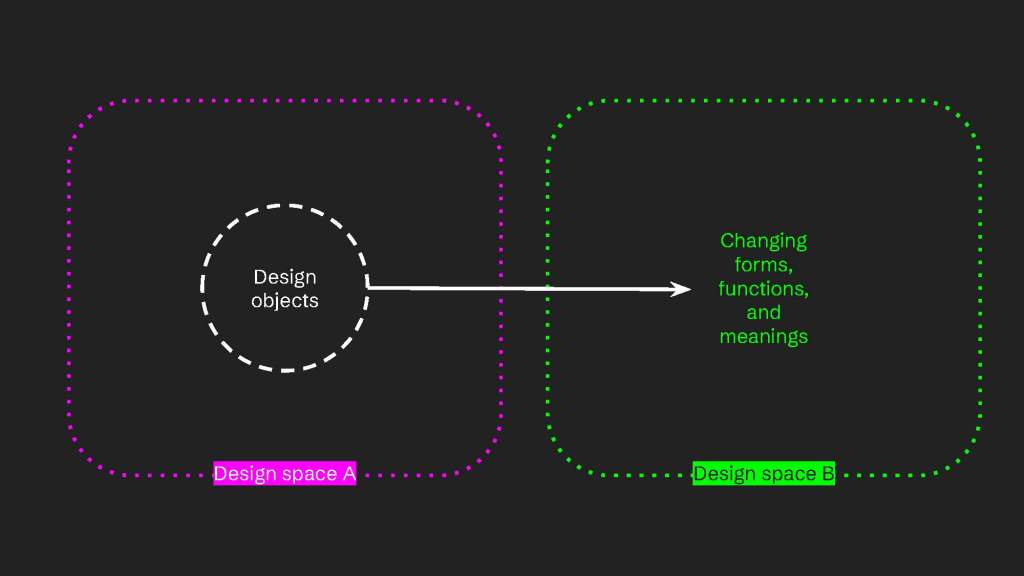
Even in the United States, we could see the variations of Christmas tree, right? So I was curious of how Christmas trees take place in Viet Nam – my home country which is very tropical in comparison to Tennessee. Here, Christmas was initially imported in the space along with the Western/European religion arrival many centuries ago. However, in the contemporary time and space, people have many creative ways to resemble the Christmas tree: It was made up from polyester counterfeits. In another one, the Christmas tree was seen in Da Nang city as the huge art installations that actually resemble the traditional food of central Viet Nam. The Christmas tree was also made from nón lá, a traditional hat in Viet Nam. Here, the design object commonly celebrated in the cold, Western space is adjusted with the materials in the local space that this culture globally travels and arrives at. Globalization (and industrialization) allows the transportation of the design objects and, thus, the expansion of the design space. However, the meanings, forms, and functions of the design object in the new spaces could be different from its original ones.

How the design object is perceived, embodied, and externalized depends on its interaction with design body, whether as the designer or user. So, I have concluded the cycle of my trajectories in observing, documenting, and analyzing the design objects. Um, let’s see if you can see that. Firstly, observing the design space as exploring and travelling across it. Secondly, pinpoint the common design object across the design spaces, which is the Christmas tree in this case. Thirdly, analyze the materials and meanings of the design objects and compare them in relation to the culture of space. The questions in analysis could be: What materials are the design objects made of? How do people use and interact with them differently? What does the design object mean to the people in that social context? Then, go back to our initial departure place to check if that design object is also there and analyze the similarity and differences in design objects from our lived experiences in that design space. This step also cycles back to the first step of the trajectory.
Again, the common questions on design objects during this trajectory: What is the form? What are the materials? What is the function? How do people interact with them? What is the meaning of that object to the people in that space?
And then, as design body, we could adjust the answers at any time to create new design objects that serve certain intentions of ours.
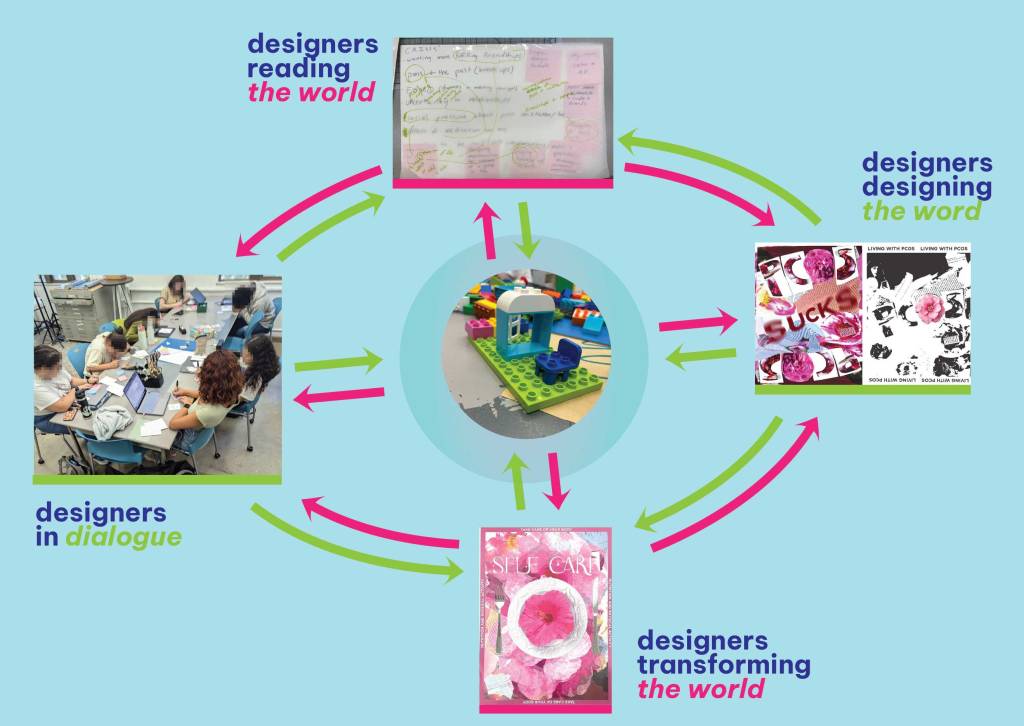
During this cycle, we can see that there is a lot of design objects and spaces to observe. I have been practicing this technique in my master’s thesis and share constant dialogues with my peers and professor. This practice has brought me to critical findings which I think would be helpful to share with you all. In your everyday life, you can document the design objects in pretty much any scenario, including the casual conversations with friends and family, collection of random design objects in your visual journal as I mentioned, or the photos in your cameral roll. During this process, I suggested you patiently observe the object in relations to the space and body that it is in the interactions with. Thus, you can print or redraw the photos of those design objects in the visual journal, if you want.
That’s pretty much it. Does that help a bit for what you can observe and document in your visual journal?
References:
- Dalsgaard, P. (2017). Instruments of Inquiry: Understanding the Nature and Role of Design Tools. International journal of design, 11(1), 21-33.
Acknowledgement: This lecture partly reflects the autoethnography method that I have been encouraged to study for my MFA thesis. This is a thank you to Dr. Frederick van Amstel and the MxD colleagues that have patiently, eagerly, and supportively been a part of this design research.

 Hiền Phan